 Equipo ViaParaguay
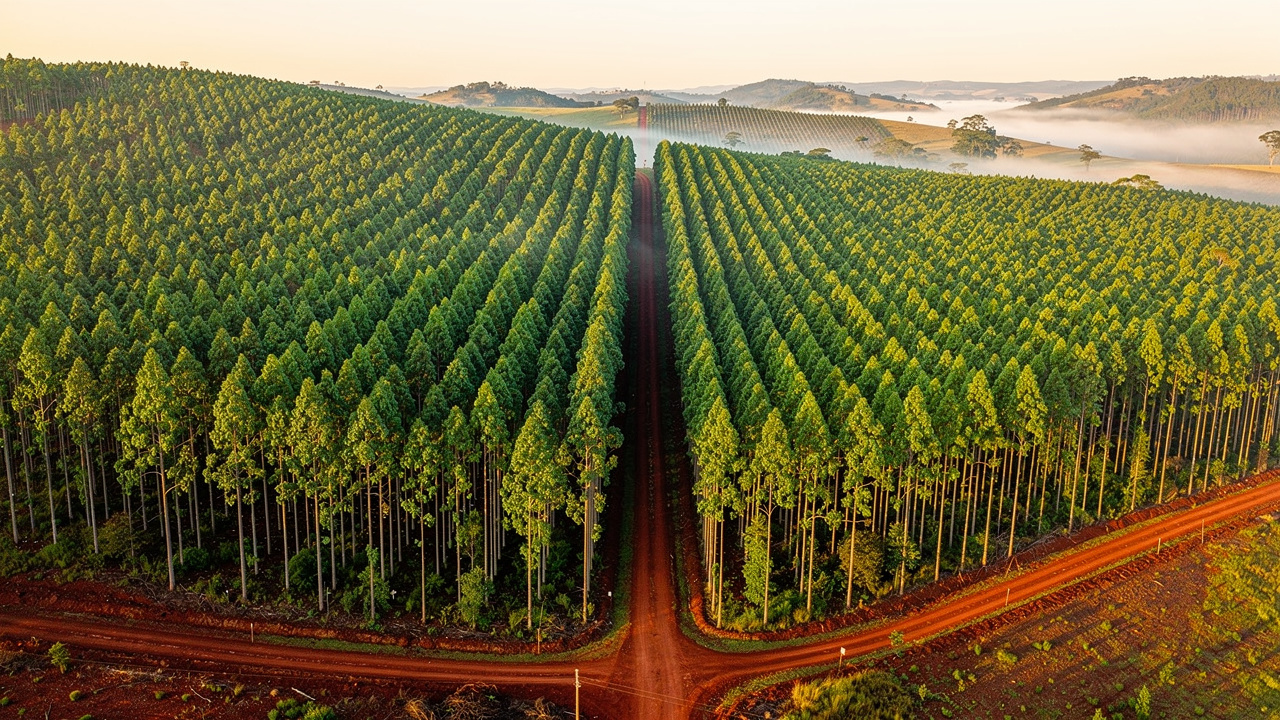
At the Paraguay Investment Forum NYC 2026, the Presidency of the Republic of Paraguay and J.P. Morgan Natural Capital announced an investment of approximately USD 200 million to develop a large-scale sustainable forestry platform in the country. J.P. Morgan Asset Management reported it in a press release dated September 24, 2026, in New York and Asunción. Before traveling to the forum, Facundo Gómez Minujín, JPMorgan's CEO for Argentina, Uruguay, Paraguay and Bolivia, explained in an interview with Bloomberg Línea what the bank sees in the country and what remains to be resolved.
What Was Announced
The project is being developed in partnership with Grupo Robinson, a Paraguayan business group with a track record in the agricultural and forestry sectors, which contributes local knowledge and production experience. According to the release, the investment focuses on:
- establishing commercial forests;
- advancing the restoration of native forest;
- producing high-quality timber, carbon credits and wood products.
The long-term vision is to industrialize the activity: process the timber inside the country, with finished products for the domestic market and for export. Capital deployment is expected to begin in early 2027, and the project is expected to create quality jobs in rural areas.
J.P. Morgan Natural Capital is the forestry land and natural assets investment manager of J.P. Morgan Asset Management; it manages more than 1.5 million acres across three continents.
The Forum Where It Was Announced
The Paraguay Investment Forum took place on September 21 and 22, 2026, in New York. It opened at the Bank of America headquarters and continued at J.P. Morgan's, with about 50 Paraguayan business leaders and 150 from other countries, according to Última Hora, citing the Presidency. On September 29, presenting the results of the New York mission, the government estimated investments of more than USD 1 billion, most of them still under evaluation, according to ABC Color.
What JPMorgan Sees in Paraguay, According to Its Executive
Gómez Minujín summed up what Paraguay did right in two short phrases: “Stability. Small state.” He then listed three advantages:
- Energy. Large rivers generate power and the country is an exporter. Bloomberg Línea links this to hydroelectric dams such as Itaipú, the binational plant Paraguay shares with Brazil.
- Location. Sitting between larger economies, the country became a logistics hub: “It used to be an abandoned country; today it is a logistics center.”
- Small state. A very small government, with “one of the lowest tax rates in Latin America,” which he says mobilizes private activity. More in our guide to the Paraguayan tax system.
The executive recalled the starting point, a landlocked country without good infrastructure, and argued that what used to be problems now turn out to be benefits. On the financial side, he described controlled inflation and high growth, with very low yields on debt. As opportunities he mentioned energy, forestry and, eventually, the roads that will be put out to tender.
The Financial Context
In 2026, according to Bloomberg Línea, JPMorgan added Paraguayan bonds in guaraníes, the country's currency, to the GBI-EM, its index of emerging-market debt in local currency. Paraguay has also held investment grade status, the credit-rating category that signals lower risk of default, from Moody's since 2024 and from Standard & Poor's since December 2025.
The World Bank forecasts that Paraguay will grow 4.4% in 2026 and 4.2% in 2027, the best performance in South America after Guyana, according to Bloomberg Línea. The staff of the International Monetary Fund (IMF), at the close of its annual mission (the Article IV consultation) on June 29, 2026, projected growth of 4.4% in 2026 and an average of 3.8% over the medium term. See also first-half GDP.
The Pending Issues the Executive Himself Flagged
Gómez Minujín named transparency, institutional strength, governance and justice as pending issues, which he described as a weakness shared by the vast majority of Latin American countries. He also pointed to dependence on the weather: Paraguay is a very agriculture-dependent country, and that affects farming, forestry and the water for the dams. On the country's credit rating, see our report on Fitch.
Those considering an investment in Paraguay can consult the ViaParaguay team through the contact form.