 Equipo ViaParaguay
In southern Paraguay, among the green hills of the Itapúa department, survive the remains of one of the most fascinating social experiments in American history: the Jesuit reductions. Trinidad and Jesús de Tavarangue —both declared UNESCO World Heritage Sites in 1993— are among the best-preserved Jesuit ruins on the continent. And the most surprising part for travelers: you'll tour them almost alone, without the crowds that overwhelm comparable sites in Peru or Mexico.
This guide explains what the reductions were, what to see at each site, how to get there from Encarnación, the updated hours and prices, and why Trinidad's nighttime light-and-sound show is worth adjusting your itinerary to catch.
What the Jesuit reductions were
Between the 17th and 18th centuries, the Society of Jesus established a network of mission-towns in this region where the Jesuits and the Guaraní people lived together in an unprecedented social, religious and economic model. These weren't simply churches: they were self-sufficient cities, with workshops, music and art schools, communal housing, farming systems and an organization that astonished the Europe of the time.
The Guaraní were not merely labor: the reductions produced sculpture, altarpieces, Baroque music and architecture of the highest level, fusing European aesthetics with indigenous sensibility. That whole world ended abruptly with the expulsion of the Jesuits from Spanish territories in 1767. The towns emptied, the jungle advanced, and what remains are these ruins that today tell, in stone, an unrepeatable story.
The decline and rediscovery
After the 1767 expulsion, the missions passed to other orders and to the colonial administration, but without the Jesuits the model fell apart. The Guaraní population dispersed, the workshops fell silent, and the following decades —marked by wars and neglect— let vegetation cover what had been one of the most prosperous urban networks in the region. For a long time, Trinidad and Jesús were little more than stone quarries for nearby buildings.
Only in the 20th century did serious appreciation of the heritage begin. Restoration campaigns rescued walls, friezes and portals from the advancing jungle, and in 1993 UNESCO inscribed Trinidad and Jesús on the World Heritage list, recognizing their exceptional universal value. That designation changed the site's fate: today it's a carefully managed cultural-tourism focus, with visitor centers, signage and the nighttime show that revived interest. To visit the ruins is, in part, to witness that rescue.
La Santísima Trinidad del Paraná
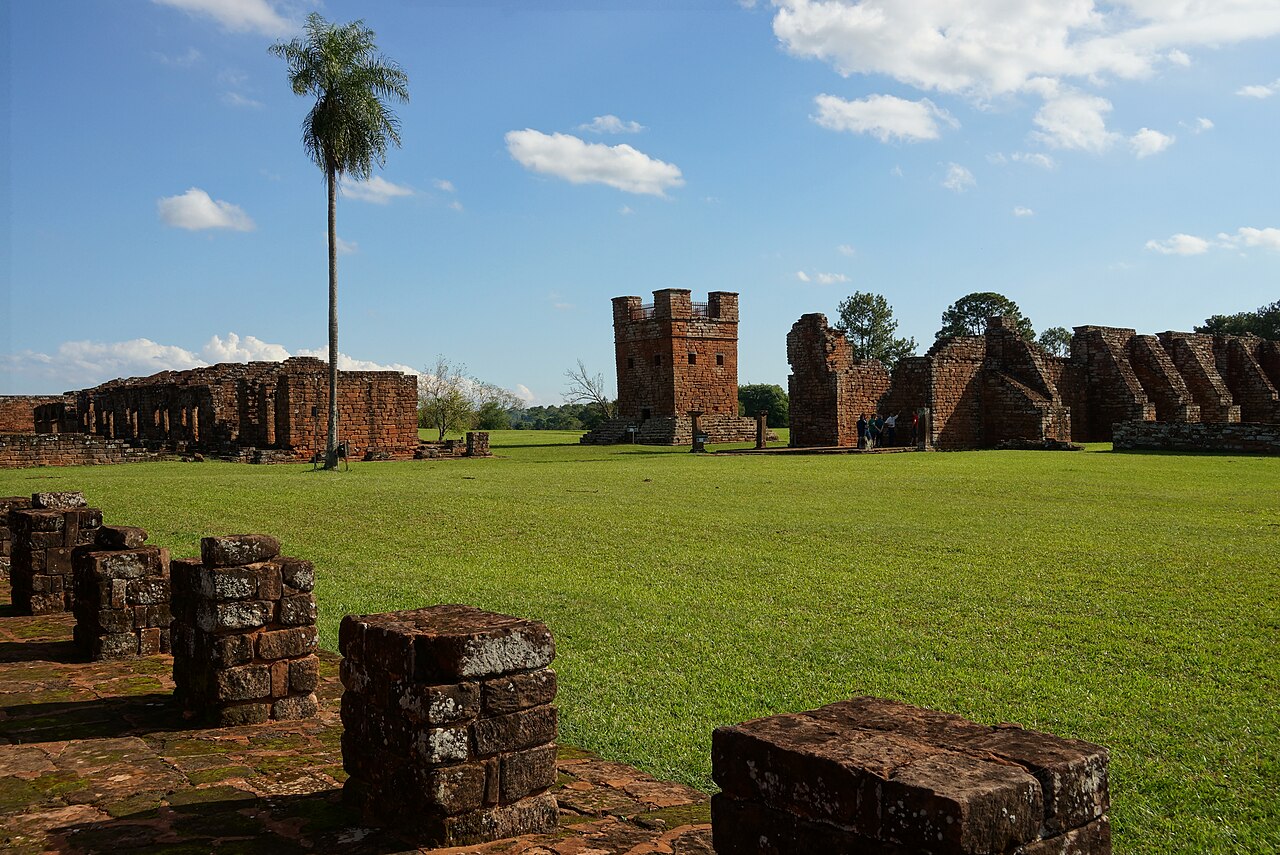
It's the main and most complete site. Founded in 1706, Trinidad preserves the main square, the remains of the great temple with its frieze of musician angels carved in stone, the tower, the college, the workshops and the Guaraní dwellings. Walking among its red sandstone walls at sunset, when the light gilds the stone, is one of those experiences that stay with you. It's where you best understand the scale and ambition of the Jesuit-Guaraní project.
Jesús de Tavarangue
A few kilometers from Trinidad, Jesús de Tavarangue is the mission left unfinished: the 1767 expulsion interrupted its construction, which is precisely why it offers a unique window into the building process. Its three Moorish-style portals stand out —the famous trilobed arches, rare in American colonial architecture— along with the sense of a monumental temple that was never completed. It's quieter and less visited than Trinidad, which adds to its charm.
San Cosme y Damián: the third corner
The entry ticket also includes the mission of San Cosme y Damián, known for its connection to astronomy: Father Buenaventura Suárez, considered the first astronomer of the Río de la Plata, worked there. Today it has an astronomical interpretation center. It completes the trio of missions you can visit with a single ticket.
The artistic legacy: the Guaraní Baroque
What sets these missions apart is not only their scale but the artistic quality that flourished in them. In the reduction workshops, Guaraní masters learned and reinterpreted European sculpture, painting and carving until they created a style of their own that historians call the Guaraní Baroque (Barroco guaraní), or Hispano-Guaraní Baroque. The musician angels of Trinidad's frieze, the saint figures, the altarpieces and the Solomonic columns testify to that fusion: European technique, indigenous sensibility.
The musical chapter is equally astonishing. The reductions had orchestras, choirs and luthiers who built their own instruments; European Baroque music —and music composed on-site— rang through these temples with a skill that stunned visitors of the era. That intangible heritage, rediscovered in scores and restorations, is part of what makes Paraguay's Jesuit experience unique.
The nighttime light-and-sound show
Wednesday through Sunday, Trinidad transforms at nightfall. The cultural tour "Lights and Sounds" illuminates the ruins and recreates, among the ancient walls and sculpted columns, the history and spirituality of the Guaraní-Jesuit encounter. It's a different experience from the daytime visit: moving, atmospheric, almost theatrical. It lasts 30 to 40 minutes and you should arrive about 20 minutes early. If your schedule allows, plan your visit to coincide with a show night: it's the highlight of the route.
Hours, prices and tickets
- Daytime visit: Monday to Sunday, summer hours 7:00 a.m. to 7:00 p.m. The tour lasts about 45 minutes.
- Nighttime show (Lights and Sounds): Wednesday to Sunday, at 8:00 p.m. (and 9:00 p.m. in summer hours). Arrive 20 minutes early.
- Admission price: 40,000 guaraníes for foreigners and 25,000 for Paraguayans. Children up to 12 enter free.
- Combined ticket: the same admission is valid for 72 hours and lets you visit the three Itapúa missions: Trinidad, Jesús and San Cosme.
Hours and fares may change by season; confirm with SENATUR (Paraguay's tourism authority) before traveling.
How to get there
The natural base for the route is Encarnación, capital of Itapúa, about 370 km from Asunción (roughly 5 hours by bus). From Encarnación, Trinidad is about 30 km along Route 6: there are regular buses that pass by the entrance, plus taxis and organized tours. Jesús de Tavarangue is about 12 km beyond Trinidad. With your own car or a tour, the three missions are comfortably covered in one or two days thanks to the 72-hour ticket.
Combine it with Encarnación
Encarnación isn't just the gateway to the route: it's a destination in itself. Its urban beaches on the Paraná River —Pacucuá, San José and Mboika'ë— are ideal in summer, and its Carnival, between January and February, is the most famous in the country. The logical plan is to dedicate the morning to the ruins and the afternoon to the city, or close the day with the nighttime show at Trinidad.
Tips for your visit
- Best time: visit Trinidad early in the morning or near sunset; the low light on the red sandstone is ideal for photos and the midday heat is intense, especially in summer.
- Footwear and water: the tour is outdoors and over uneven ground. Bring comfortable shoes, a hat, sunscreen and water.
- Local guide: hiring a guide on-site greatly enriches the visit; the Guaraní-Jesuit history makes sense when someone tells it to you among the stones.
- Plan the night: if you want the light show, confirm the day and time in advance and consider sleeping in Encarnación so you don't drive the route at night.
Keep exploring
- Paraguay Travel Guide 2026: what to see and do
- Tourism overview: Iguazú, the Chaco, Jesuit ruins and the Pantanal the world doesn't know
- How to travel to Paraguay: visa, requirements and how to get there
Frequently asked questions
How much time do I need for the Jesuit route?
With a full day you can cover Trinidad and Jesús at a relaxed pace. If you want to add San Cosme and the nighttime show, two days is ideal. The 72-hour ticket gives you plenty of margin.
Is the nighttime show worth it?
For many visitors it's the most memorable moment. Seeing the ruins illuminated with the narration of Guaraní-Jesuit history is a different experience from the daytime visit. If your trip falls between Wednesday and Sunday, don't miss it.
Can you also visit the missions on the Argentine side?
Yes. Across the border, in Argentina, are San Ignacio Miní and other reductions. Many travelers combine both countries in a wider Jesuit circuit, crossing at Encarnación-Posadas.
Image: Maurice Chédel — Wikimedia Commons (CC BY-SA 3.0)
Trinidad and Jesús are not the only Jesuit trace you can visit. In Misiones, four museums hold the art of the reductions — San Ignacio Guazú, Santa María de Fe, Santa Rosa de Lima and Santiago — with their hours and admission in the guide to Paraguay's theaters, museums and cultural centers.