 Equipo ViaParaguay
When six countries sign an agreement to "liberalize" airspace, the question that matters is simple: does this mean more flights, more destinations and more competition to and from Asunción, and when? The honest answer is: not yet. What Paraguay, Argentina, Brazil, Chile, Bolivia and Uruguay signed between July 14 and July 22, 2026 is an institutional roadmap with a deadline of July 2027, not open skies already in effect. And while Paraguay chairs that regional process, its own flag carrier is going through an operational crisis and its most ambitious route, to the United States, remains without a date.
Who signed
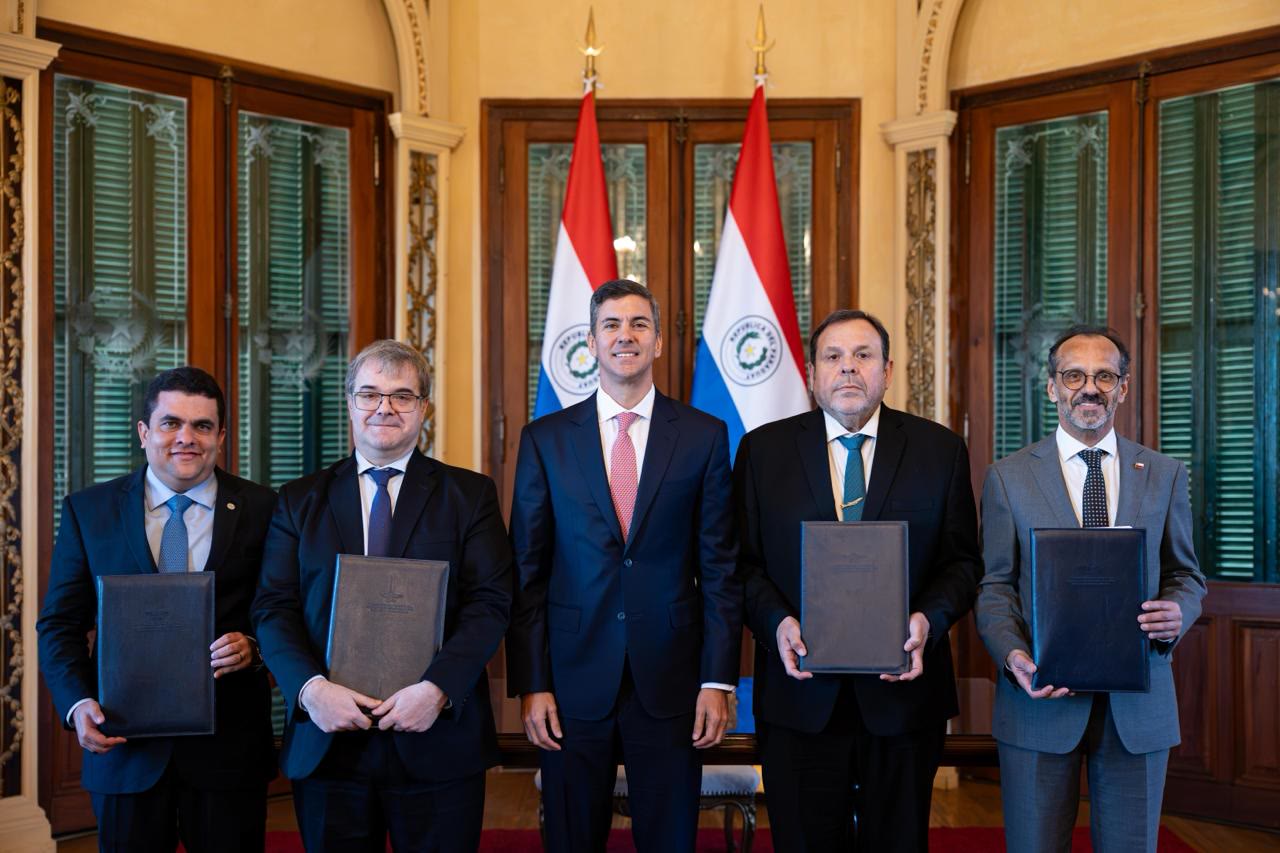
On July 14, 2026, at the Palacio de López — seat of Paraguay's executive branch, in Asunción — Paraguay, Argentina, Brazil and Chile signed the South American Air Liberalization Agreement (ALAS, its Spanish acronym), a Memorandum of Understanding toward the so-called South American Single Sky. The signatories were Nelson Mendoza, president of the National Civil Aviation Directorate (DINAC, Paraguay's civil aviation authority), with President Santiago Peña present; Hernán Gómez, Argentina's Undersecretary of Air Transport; and Tiago Chagas Faierstein, director-president of Brazil's National Civil Aviation Agency (ANAC). "South America needs to be more integrated," Faierstein said. Gómez called the agreement "very ambitious": "It's historic for the region." Press coverage — though not the two official sources checked for this piece, DINAC and Agencia IP — identifies Chile's signatory as David Dueñas Santander, secretary general of Chile's Civil Aeronautics Board.
From four countries to six
Eight days later, on July 22, Bolivia and Uruguay formalized their accession at the 109th Executive Committee meeting of the Latin American Civil Aviation Commission (CLAC, the region's civil aviation body), held in the Dominican Republic. That brought the bloc to six countries in total: the four original signatories plus Bolivia and Uruguay.
What ALAS is, and isn't
ALAS is a Memorandum of Understanding, not a binding treaty. It doesn't create new bodies or immediate legal obligations; it commits each country's aviation authorities to coordinate, progressively, the opening of regional airspace. The declared long-term goal is the multilateral, reciprocal granting of all air freedoms recognized by ICAO (the International Civil Aviation Organization, the UN's civil aviation body): the permissions one country grants to another's airlines to operate within its territory, up to the ninth freedom. The fifth freedom lets a foreign airline carry passengers between two countries other than its own, as long as the route starts or ends at home. The seventh goes further, allowing flights between two foreign countries without touching the airline's home country at all. The ninth, the broadest of all, enables cabotage: a foreign airline flying domestic routes within another signatory country, something almost always reserved for local carriers today.
Paraguay chairs it, with a 2027 deadline
Paraguay is not just another signatory: through DINAC, it holds the executive coordination of the agreement for its first two years, chairing the Executive Working Group made up of aviation-authority representatives from the six countries. According to Brazil's ANAC, that group must present a proposal for the progressive implementation of the deal within a year of signing, by around July 2027; until then, ALAS remains a roadmap, not an immediate operational change. DINAC itself describes the memorandum as a "roadmap to advance toward a Regional Single Air Transport Market," built on four pillars: progressive liberalization, regulatory harmonization, technical cooperation and operational facilitation. "At DINAC we keep pushing forward actions that strengthen civil aviation and establish Paraguay as a strategic player for the region's — and the world's — connectivity," the agency said.
That same July 14, Paraguay also signed a second memorandum, bilateral and exclusive to Brazil, to modernize the Air Services Agreement already in force between the two countries (source: Agencia IP): it moved on two fronts that day, the regional one and the bilateral one.
The timeline, according to Mendoza
In an interview with ABC Color on July 15, Mendoza laid out concrete expectations: the first meeting of delegations was expected 30 to 40 days after signing, and bilateral progress was already underway — Paraguay and Argentina toward the ninth freedom, and Paraguay with Brazil and with Chile toward the seventh. Those are projections from that interview, not from the text of the signed memorandum, which doesn't specify timelines or country-specific freedoms.
Not the region's first attempt
ALAS isn't starting from scratch. Its most direct precedent is the Fortaleza Agreement, a subregional air transport system created in 1996 and in force since 2001 among Argentina, Bolivia, Brazil, Chile, Paraguay, Peru and Uruguay (source: Chile's Civil Aeronautics Board). Paraguay has also been moving bilaterally: in August 2024 it joined Argentina's "Open Skies" policy, and in April 2026, at the 108th Executive Committee meeting of CLAC, it updated its bilateral treaty with Bolivia, in force since 1958, aligning it with an open-skies framework covering the fifth, sixth and seventh freedoms (source: DINAC).
The real contrast: regional coordination and a local crisis, at once
While Paraguay chairs the regional air-opening agreement, its domestic aviation situation is, at best, uneven. Asunción's Silvio Pettirossi International Airport — on the outskirts of the city and practically the country's only significant international air entry point — closed 2025 with a historic record: it topped 1.28 million passengers (exact figures vary depending on the outlet citing DINAC), with year-over-year growth of 9.4% over the pre-pandemic 2019 figure (1,271,976 passengers). The terminal was also expanded to a capacity of 4 million passengers a year — the base any future route growth builds on, and the entry point for anyone planning to explore the country or who first needs to sort out visa and entry requirements.
But the airline landscape flying to and from Paraguay shows real strain. In June 2026, Paranair — the Paraguayan airline — was authorized to fly direct from Asunción to northern Argentina, Chile and Bolivia, without a Buenos Aires stopover, even as it goes through a serious operational crisis: debts, cancellations, and a fleet running mainly on a single aircraft. DINAC itself warned of a possible financial audit and ordered a cut in authorized foreign frequencies after passenger complaints (sources: Diario HOY, Airline92, Aviacionline). Add to that GOL, which had announced Asunción–Miami — the world's longest flight operated with a Boeing 737 MAX — planned for June 2026 and rescheduled with no new date, which the airline attributed to fuel costs. Silvio Pettirossi had already secured U.S. TSA certification, an essential prerequisite for that kind of route.
Why this matters to you
If you're looking at Paraguay as a destination for investment, travel or a possible move, air connectivity is background infrastructure: more routes and more operating freedoms tend to translate, over time, into more flow of people, business and demand. But the honest read is this: ALAS is a roadmap with a July 2027 deadline, not open skies already in effect. Paraguay currently chairs the coordination of that regional process while its flag carrier faces an operational crisis and its most ambitious route to the United States remains without a date. Both things are true at once.
Air connectivity is only half the map: Paraguay, a landlocked country, is also advancing its overland connectivity through the Bioceanic Corridor. If you're weighing a move to the country, check our residency guide by nationality, and for specific questions, reach us through contact.
Cover photo: signing ceremony at the Palacio de López, 14 July 2026. Credit: Agencia IP (Paraguayan Information Agency).