 Equipo ViaParaguay
Paraguay is now the fourth country in the world in Bitcoin mining, behind the United States, Russia, and China. That's according to Hashrate Index, a firm that closely tracks the bitcoin mining industry: its most recent estimate, covering the second quarter of 2026, puts Paraguay at 4.3% of global hashrate, roughly 43 EH/s. Hashrate is the total computing power that secures the Bitcoin network — the more hashrate a country contributes, the more mining capacity it has installed there — and it's measured in EH/s, or exahashes per second, a unit that groups trillions of calculations performed every second by computers dedicated to mining. Mining bitcoin, in simple terms, is the process by which thousands of those computers compete with each other to validate the network's transactions and add the next block to the chain, earning a reward in the cryptocurrency itself in return; the more of those computers a country hosts, the larger its share of global hashrate.
The figure isn't an official census or a government statistic: Hashrate Index builds it by combining data from major mining pools — the services where miners group their computing capacity — rather than a direct measurement of every operation in the country. With that caveat in mind, the trend is still clear. In the previous snapshot, from January 2026 and based on fourth-quarter 2025 data, the global ranking was: the United States at 37.5% of hashrate, Russia at 16.4%, China at 11.7%, Paraguay in fourth place at 4.0%, the United Arab Emirates at 3.1%, and Oman at 3.0%. Paraguay's share rose from 4.0% to 4.3% between those two snapshots, with capacity steady at around 43 EH/s: the percentage also shifts as global hashrate grows, even when a country's installed capacity doesn't change.
The Advantage Behind Fourth Place
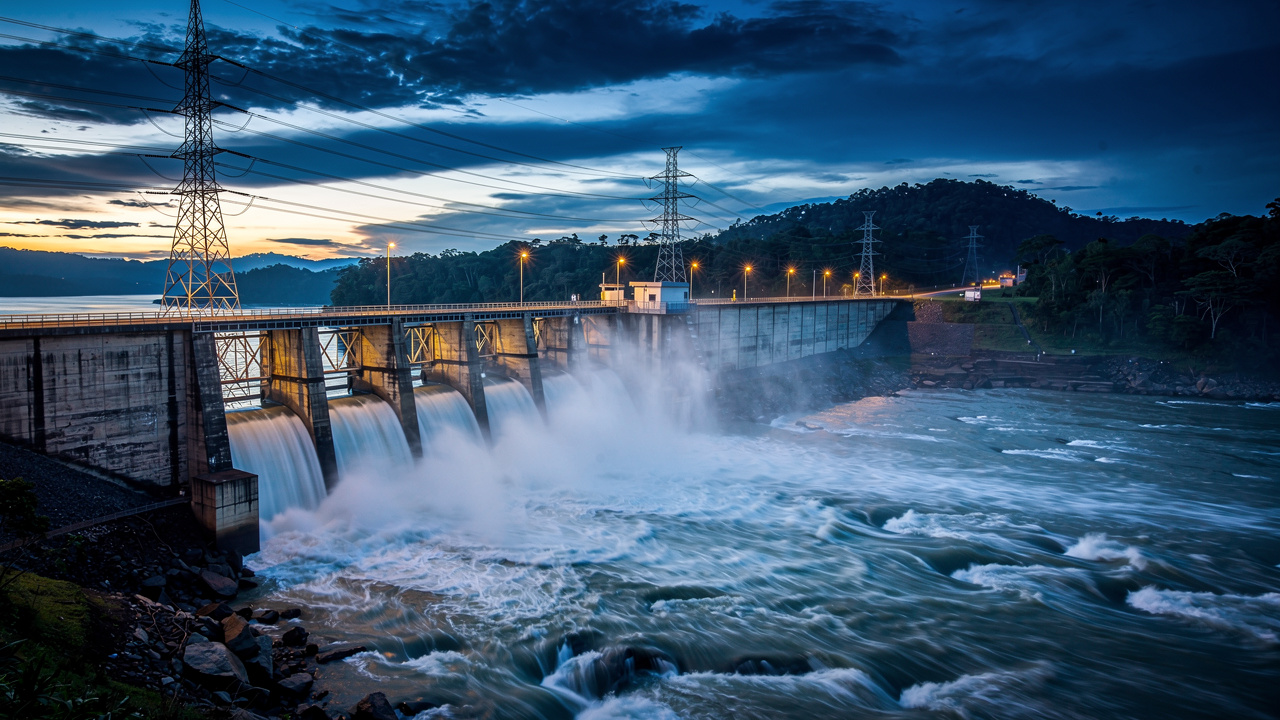
The reason behind the ranking is energy. Paraguay generates practically 100% of its electricity from hydropower: Itaipú, one of the largest hydroelectric plants in the world, run jointly with Brazil; Yacyretá, run jointly with Argentina; and Acaray, entirely Paraguayan-operated. Combined, the three have a nominal capacity of 8,760 MW, though the figure depends on hydrology at any given time. All three plants make up an electricity grid that doesn't depend on fossil fuels, a trait that's uncommon even among the countries leading the global mining ranking. In the first half of 2026 alone, Itaipú supplied 14,603 GWh to ANDE, the state power utility, up 20.6% year over year; from January through July 2026, the total reached 16,876 GWh.
ANDE — the National Electricity Administration, Paraguay's state-owned utility, which generates and distributes all of the country's electricity — isn't an independent regulator: it sets its own tariffs by administrative resolution, not as the outcome of a competitive electricity market. Paraguay consumes only a fraction of the energy it's entitled to under the Itaipú and Yacyretá treaties, and resells the rest. That combination — clean generation, low domestic consumption, and available surplus — is what explains Paraguay's industrial electricity rates, among the lowest in the region, and what first drew Bitcoin mining and later other energy-intensive industries, including the growing artificial intelligence and data center hub now taking shape in the country, and the green fertilizer plant that Atome is building in Villeta, drawn by that same clean, cheap energy. ANDE itself notes that the energy surplus is guaranteed "in the short term," while it looks for new generation sources to sustain it going forward.
Mining by the Numbers
According to the Paraguayan Fintech Chamber, cited by ABC Color in July 2026, about 1,000 MW of Paraguay's electricity matrix is currently tied to Bitcoin mining. The same source states that 60% of the revenue ANDE earns from selling its surplus comes from that activity.
The map of operators has consolidated. In 2026 there are 41 licensed operators, with a total of 943.8 MW reserved — each reserved megawatt is the electric capacity an operator contracts to power its mining farms — and four companies among them account for 730 MW. A year earlier there were 71 operators — a 42% drop in the number of active companies. But contracted power held steady or grew over the same period, which describes consolidation into fewer, larger players, not a flight of installed capacity.
The 2027 Deadline
All current mining contracts with ANDE expire on December 31, 2027. ANDE describes that deadline as "non-negotiable," and has already signaled what it plans to do with that power: reallocate it to artificial intelligence and industrial projects, the same sectors now exploring a move into the country for the same energy advantage — like Yguazú Digital, the AI hub Paraguay launched together with Taiwan. Facing that regulatory uncertainty, some mining operators have already relocated to other countries in the region. Exactly what happens to the 943.8 MW currently reserved for mining once 2028 begins is still a decision that rests with ANDE. For current operators, that date works as a firm planning limit: whatever ANDE ultimately decides, no active contract extends past December 31, 2027.
An Activity With No Law of Its Own
A lesser-known fact is that Paraguay has no law regulating cryptoasset mining. A bill that would have done so existed, but the Executive Branch vetoed it in August 2022, and it never became law. Today the activity is governed by a set of lower-tier rules: ANDE's own charter (Law 966/64), Executive Decree 7824/2022, and a special tariff schedule set by ANDE Resolution 46,984, which applied increases of between 6% and 58% to sector rates. That absence of a law doesn't mean the activity is banned or unregulated: it means the rules can change through a board decision and an administrative resolution, at a different pace than a reform passed by Congress. In other words, Bitcoin mining in Paraguay isn't regulated by Congress through a law — it's regulated by the state utility itself, through administrative resolution.
What to Watch Between Now and 2027
Paraguay arrives at this moment with a consolidated position — fourth in the world, on an energy base that doesn't depend on fossil fuels — and with an open decision still to come that will shape the sector after 2027. For anyone weighing participation in Paraguay's digital economy, whether in mining, artificial intelligence, or another energy-intensive sector, the fundamentals are a good starting point: the country holds investment grade from Moody's and S&P, and offers several corporate structures for operating formally, from the SA to the SRL. The ViaParaguay team can help evaluate an investment in this context through the contact form.